
In the rapidly evolving landscape of e-commerce, the ability to create compelling and effective product descriptions is paramount. Traditionally, this task has been labor-intensive, requiring significant time and effort from marketing teams. However, the advent of product description AI is revolutionizing how businesses approach this crucial aspect of online retail. This article delves into the transformative impact of AI on product descriptions, exploring its benefits, challenges, and future trends.
The Evolution of Product Descriptions
Product descriptions have come a long way from simple lists of features. They are now recognized as a critical component of the customer journey, influencing purchasing decisions and shaping brand perception. Understanding this evolution is essential to appreciating the role of AI in further optimizing this process.
From Manual Writing to Automated Generation
Initially, product descriptions were crafted manually by copywriters, who meticulously researched each item and wrote persuasive copy. This process, while effective in the hands of skilled writers, was time-consuming and costly, especially for businesses with large product catalogs. As e-commerce grew, the need for more efficient solutions became apparent. The emergence of automated product descriptions marked a significant shift, allowing businesses to generate descriptions more quickly, albeit often at the expense of quality and personalization.
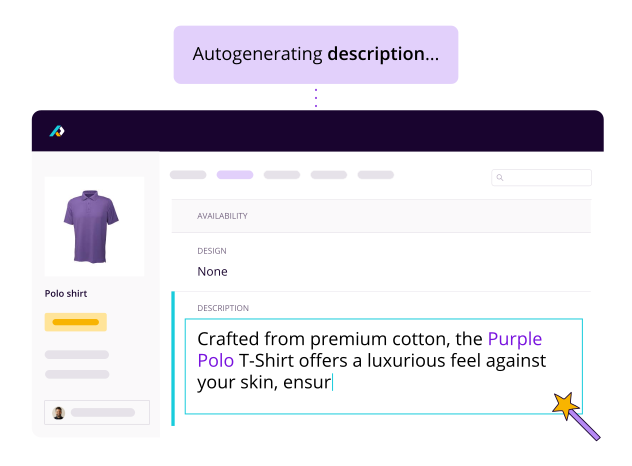
The integration of AI takes automated generation to the next level. AI-powered tools can analyze vast amounts of data, including product specifications, customer reviews, and market trends, to create descriptions that are not only accurate and informative but also engaging and persuasive. This represents a significant leap forward in terms of both efficiency and effectiveness.
The Impact of AI on E-Commerce
AI is transforming various facets of e-commerce, from personalization and customer service to supply chain management and fraud detection. Its impact on product descriptions is particularly noteworthy, as it directly affects the customer experience and conversion rates. By automating and optimizing the creation of product descriptions, AI enables businesses to:
- Scale their content creation efforts without sacrificing quality.
- Personalize descriptions to target specific customer segments.
- Improve search engine optimization (SEO) by incorporating relevant keywords.
- Enhance the overall shopping experience by providing clear and compelling information.
The result is a more efficient, effective, and customer-centric approach to e-commerce.
Future Trends in Product Description Technology
Looking ahead, the future of product description technology is likely to be shaped by several key trends. One is the increasing sophistication of AI algorithms, which will enable them to generate even more nuanced and persuasive copy. Another is the integration of multimedia elements, such as images and videos, into product descriptions. This will allow businesses to create more immersive and engaging experiences for their customers.
Furthermore, the rise of voice search and conversational commerce will necessitate the development of product descriptions that are optimized for voice assistants and chatbots. This will require AI to understand natural language queries and generate responses that are both informative and conversational.
Benefits of AI-Powered Product Descriptions
The adoption of AI in product description creation offers a multitude of benefits for e-commerce businesses. These advantages span increased efficiency, improved conversion rates, and enhanced customer experiences.
Increased Efficiency and Productivity
One of the primary benefits of AI-powered product descriptions is the significant increase in efficiency and productivity. Traditional product description writing is a time-consuming process, often requiring hours of research and writing for each item. AI can automate this process, generating descriptions in a fraction of the time. This allows businesses to:
- Quickly populate their online stores with detailed product information.
- Free up their marketing teams to focus on other strategic initiatives.
- Reduce the costs associated with manual content creation.
For businesses with large product catalogs, the time and cost savings can be substantial.
Improved Conversion Rates and Sales
Compelling product descriptions are essential for driving conversions and increasing sales. AI can help businesses optimize their descriptions to maximize their impact on potential customers. By analyzing data on customer behavior and market trends, AI can identify the key elements that resonate with shoppers and incorporate them into the descriptions. This can lead to:
- Higher click-through rates (CTRs) on product pages.
- Increased add-to-cart rates.
- Improved conversion rates and sales revenue.
Moreover, AI can personalize descriptions to target specific customer segments, further enhancing their effectiveness. For example, a product description for a high-end item might emphasize its luxury features and benefits, while a description for a budget-friendly item might focus on its value and affordability.
High-quality, persuasive product descriptions are crucial for boosting sales and enhancing the overall shopping experience.
Enhanced Customer Experience
In today's competitive e-commerce landscape, customer experience is a key differentiator. AI can help businesses enhance the customer experience by providing clear, accurate, and engaging product information. When customers have access to detailed and informative descriptions, they are more likely to make informed purchasing decisions and be satisfied with their purchases. This can lead to:
- Increased customer loyalty and repeat business.
- Positive reviews and word-of-mouth referrals.
- A stronger brand reputation.
Furthermore, AI can help businesses create a more consistent and cohesive brand experience across all of their product pages. By ensuring that all descriptions adhere to a consistent style and tone, businesses can reinforce their brand identity and build trust with their customers.
Overcoming Challenges and Limitations
While AI offers significant benefits for product description creation, it is important to acknowledge its limitations and address the challenges associated with its implementation. Ensuring accuracy, avoiding generic content, and maintaining brand voice are crucial considerations.
Ensuring Accuracy and Relevance
One of the primary challenges of using AI for product descriptions is ensuring accuracy and relevance. AI algorithms are only as good as the data they are trained on, and if the data is incomplete or inaccurate, the resulting descriptions may be flawed. It is essential to:
- Carefully curate and validate the data used to train the AI.
- Implement quality control measures to review and edit the generated descriptions.
- Regularly update the AI with new information and feedback.
Additionally, it is important to ensure that the AI is able to understand the nuances of different product categories and target audiences. A description that is appropriate for one product may not be suitable for another.
Maintaining accuracy and relevance is paramount for building trust with customers and avoiding negative reviews.
Avoiding Generic or Repetitive Content
Another challenge is avoiding generic or repetitive content. AI algorithms can sometimes generate descriptions that lack originality or fail to capture the unique characteristics of a product. To avoid this, it is important to:
- Use a variety of data sources to train the AI.
- Incorporate creativity and storytelling elements into the descriptions.
- Regularly monitor and refine the AI's output to ensure that it is fresh and engaging.
Generic content can harm SEO rankings and fail to capture the attention of potential customers. Original and engaging descriptions are essential for standing out in a crowded marketplace.
Maintaining Brand Voice and Style
Maintaining a consistent brand voice and style is crucial for building brand recognition and loyalty. AI-generated descriptions should align with the overall tone and messaging of the brand. To achieve this, it is important to:
- Train the AI on a corpus of existing brand content.
- Provide clear guidelines on brand voice and style.
- Regularly review and edit the generated descriptions to ensure consistency.
A disjointed brand voice can confuse customers and weaken brand identity. Consistent messaging across all touchpoints is essential for building a strong brand.

AI copywriting for e-commerce is transforming the way businesses create product descriptions, offering significant benefits in terms of efficiency, conversion rates, and customer experience. While challenges remain, such as ensuring accuracy and maintaining brand voice, these can be overcome with careful planning and implementation. As AI technology continues to evolve, its role in product description creation will only become more prominent, helping businesses to thrive in the competitive world of online retail. Embracing AI content generation is no longer a luxury but a necessity for businesses looking to stay ahead of the curve and deliver exceptional experiences to their customers. The future of product description optimization lies in the intelligent application of AI, enabling businesses to unlock the full potential of their product catalogs and drive sustainable growth. Ultimately, the effective use of AI product description generator tools will be a key differentiator in the success of e-commerce businesses in the years to come. By optimizing product listings with the assistance of AI, you can attract more customers with improved conversion rates and sales. By using AI for online retail, you can create compelling and effective product descriptions is paramount. Businesses can also scale their content creation efforts without sacrificing quality by using product description software.


Messenger